
Latest posts
-
What Counts as a Low-Light Video Test Pass for an FPV Drone?
Define a pass before judging the picture A low-light FPV video test is useful when one named camera-to-display configuration meets a predefined criterion under recorded conditions. A brighter image alone is not a pass. Separate the requirem
-
Low-Light FPV Video for AI: Evaluate Evidence, Not Brightness
A low-light image can look brighter and still become less useful to an AI system. Gain, exposure and image processing may improve the operator preview while noise, motion blur, clipping or compression removes the edges, texture and timing i
-
FPV Video-to-Control Interfaces: Define the Handoff
Keep the video and control paths explicit An FPV drone combines a camera path, a receiving and display path, and a flight-control path. These paths interact, but a clear picture or an onboard processing result does not prove that the comple
-
From FPV Video Demo to OEM Evaluation: Is the Input Ready?
A demonstration starts the discussion A clear FPV video demonstration shows one configuration under one set of conditions. It does not establish that the same module, cable, power supply and receiving equipment will behave identically in a
-
Replacing an FPV Camera: A Video-Path Revalidation Checklist
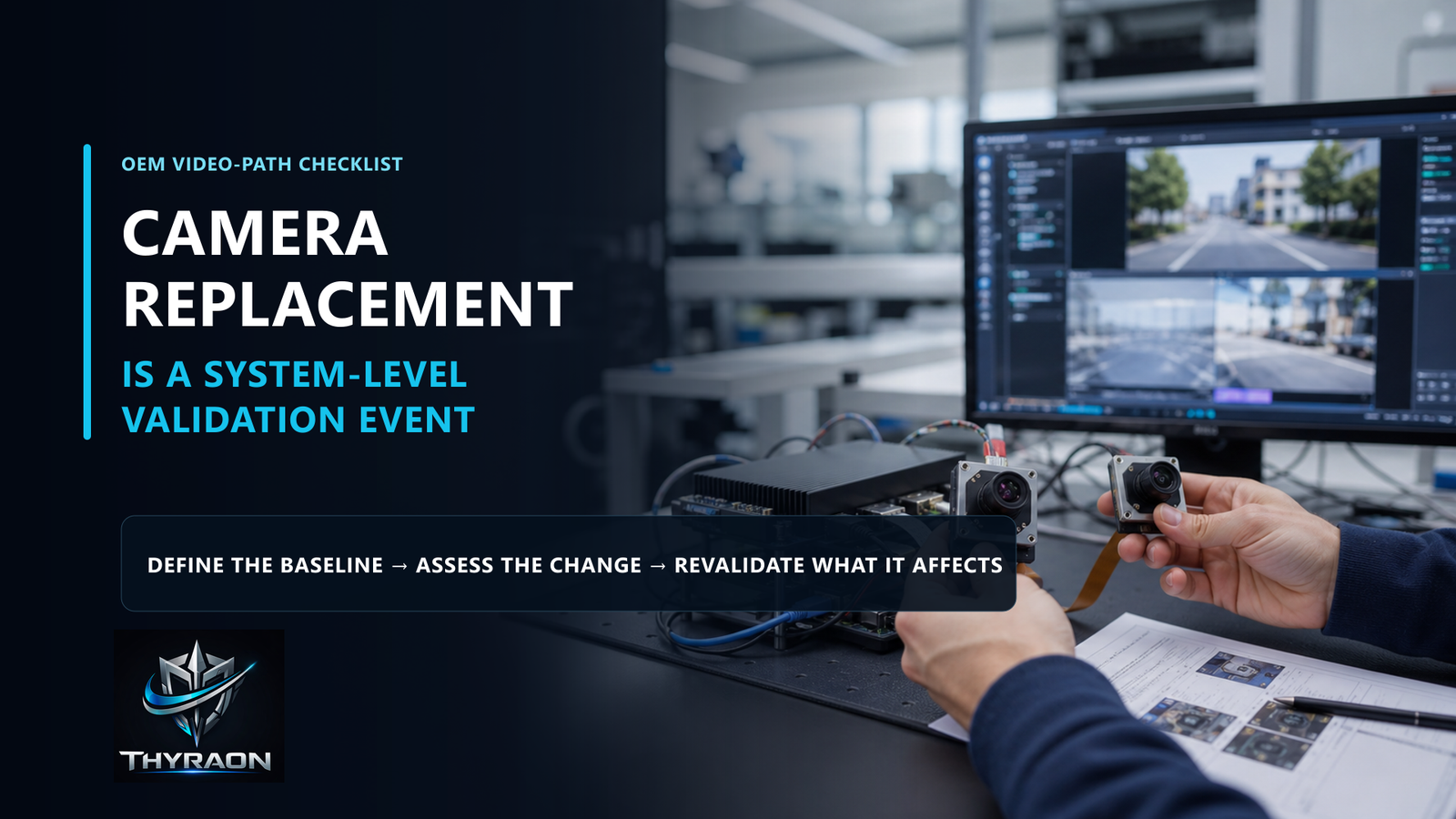
Short answer: replacing an embedded camera module should trigger an impact review across the complete video-input path. Matching resolution, frame rate or interface name does not guarantee matching electrical behaviour, format, latency, rec
-
FPV Video Input Readiness: 7 Questions Before OEM Design-In
A camera module should not enter an OEM design only because it powers on, streams video and matches a nominal interface. For FPV drone, the video module is the beginning of a machine-information path: CAMERA → INTERFACE → COMPUTE → VIDEO PI