
A low-light image can look brighter and still become less useful to an AI system. Gain, exposure and image processing may improve the operator preview while noise, motion blur, clipping or compression removes the edges, texture and timing information required by the downstream task.
For an OEM team, the relevant question is not whether video looks impressive in darkness. It is whether the exact deployed camera-to-compute path preserves the information required by the intended task across a defined low-light operating envelope.
Why brightness is an incomplete measure
Brightness describes only one aspect of the delivered image. When illumination falls, the imaging system must manage fewer photons, sensor noise, exposure time, gain, frame continuity and any downstream enhancement or encoding.
A longer exposure can collect more light but also increase motion blur. Higher gain can raise the displayed signal but also make noise more visible. Aggressive denoising can create a cleaner-looking image while removing fine structure. Tone mapping can reveal some dark areas while compressing contrast elsewhere.
None of these changes is automatically good or bad. Their value depends on the task, operating conditions and exact output delivered to inference.
Low-light readiness is the ability to preserve task-relevant evidence, not simply the ability to display a bright frame.
Start with the task envelope
Define what the system needs to observe before selecting a camera or image setting. Record representative target type, minimum target size in the image, working distance, field of view, contrast, platform and target motion, illumination level, transition rate, glare, backlight and required frame continuity.
These conditions form an evaluation envelope, not a universal performance claim. A successful result in one static scene does not prove performance for a moving FPV drone under different illumination and geometry.
Name the exact video configuration
Low-light behaviour belongs to a complete configuration. Record the camera model and hardware revision, lens, aperture if adjustable, focus, mount, image mode, frame rate, exposure policy, gain limits, interface, encoder, host and preprocessing version.
Two configurations can show the same nominal resolution while collecting and delivering different information. A lens change can alter target scale and light collection. A frame-rate change can alter available exposure time. A crop, resize or compression setting can change the evidence presented to the model.
The accepted configuration should be reproducible. If one element changes, decide whether the low-light evidence remains valid or requires re-evaluation.
Measure the camera path, then test the task
Objective sensor and camera characterization is useful because it separates measurable properties such as sensitivity and noise from subjective impressions. It helps engineering teams compare imaging behaviour under controlled conditions.
It does not replace task-level validation.
An OEM evaluation needs both layers:
- Imaging evidence: controlled measurements and repeatable observations of signal, noise, exposure behaviour and image delivery.
- Task evidence: whether the downstream algorithm receives enough target information under representative conditions.
A datasheet value cannot by itself predict the result of a particular lens, movement, illumination transition, encoder and AI pipeline. Conversely, one successful algorithm demonstration does not characterize the camera generally.
Inspect the delivered AI input
The operator preview may not be the same image used by the model. Between the camera and inference, the path may apply demosaicing, colour conversion, noise reduction, tone mapping, cropping, resizing, rectification, normalization or compression.
Trace the complete path:
SCENE → SENSOR AND OPTICS → EXPOSURE AND GAIN → VIDEO DELIVERY → PREPROCESSING → AI INPUT
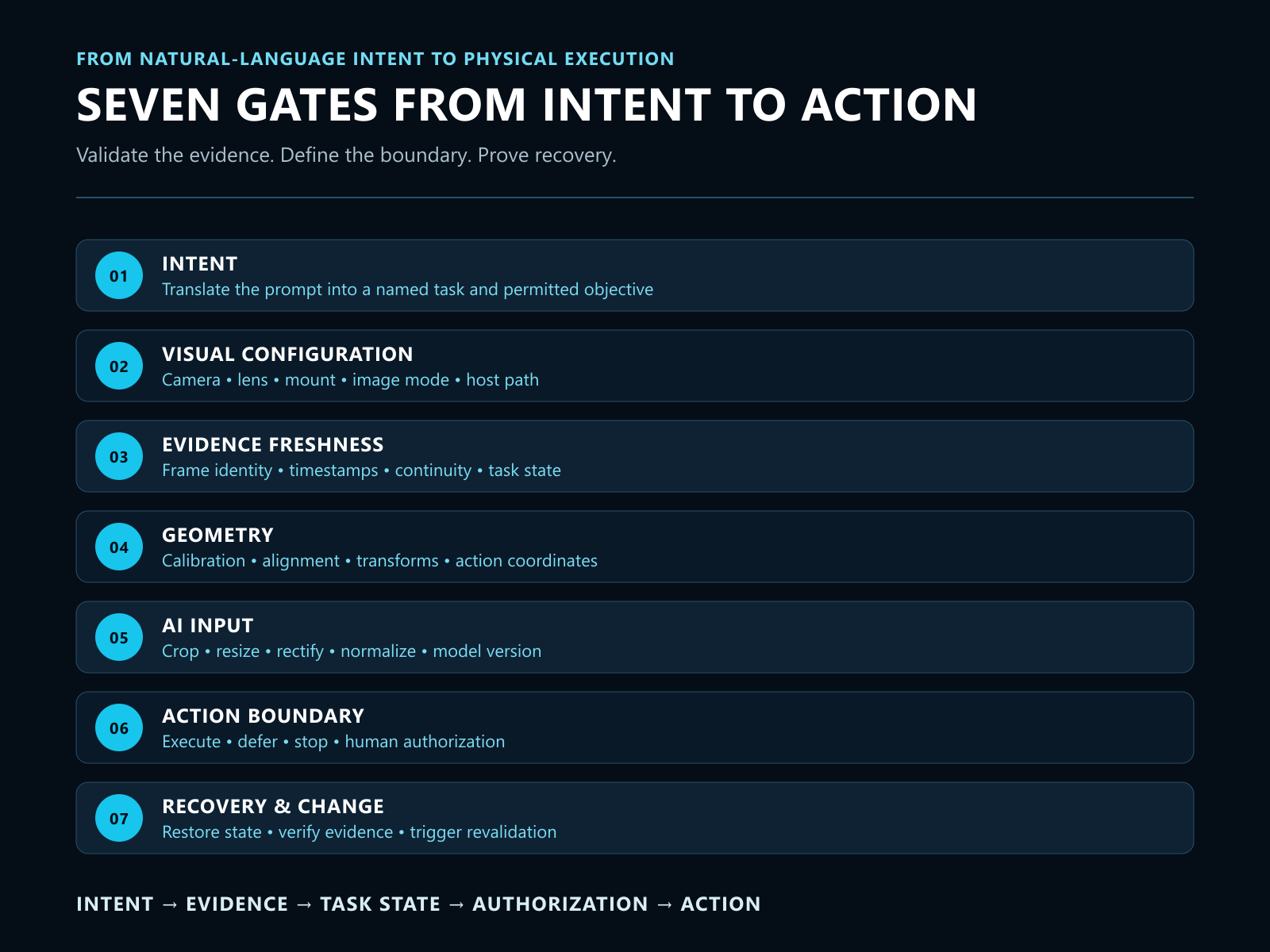
At each stage, record the owner, configuration, output and acceptance check. Save representative model-input frames where possible, together with the configuration and condition that produced them.
This prevents a common review error: approving a visually attractive display while the model receives a smaller, noisier, delayed or differently processed input.
Test transitions, not only steady darkness
Many deployment failures occur during change rather than at a fixed light level. A platform may move from daylight into shadow, pass a bright lamp, face vehicle headlights or experience alternating illumination caused by motion.
Test whether exposure and gain control settle within an acceptable time. Observe clipping, oscillation, frame drops, colour changes and the effect on task output. If the platform or target moves, test the trade-off between exposure time and motion blur.
The acceptance condition should state what information must remain available and how quickly the system must recover. It should not rely on a label such as “good low-light performance.”
Include encoding and transport
Low-light noise can interact with compression. A noisy image may require more bits to encode, while limited bandwidth or aggressive compression may remove detail or create block artefacts. Frame timing and continuity may also change under load.
Where the architecture includes encoding or transmission, evaluate the final decoded input under the intended bitrate, transport, host load and recovery conditions. A clean local sensor output does not prove that the remotely delivered AI input is equivalent.
Test degraded states and recovery
Representative tests may include illumination below the intended envelope, rapid bright-to-dark transitions, motion blur, partial occlusion, low target contrast, dropped frames, bandwidth pressure, restart, incorrect exposure or preprocessing configuration, and recovery to the approved state.
Record whether the condition is detected, whether downstream processing continues, whether stale or unsuitable input can be used, and what evidence is required before the system trusts the video again.
Recovery is not only the return of a visible stream. It is the restoration of the accepted configuration and task-relevant information path.
Build a compact OEM acceptance record
A useful low-light evaluation record should answer:
- Which exact hardware and software configuration was tested?
- What scene, target, geometry, motion and illumination envelope was used?
- What video reached the downstream model?
- Which task-relevant information was preserved or lost?
- How did the path behave during transitions and degraded states?
- Which result passed, failed or remains unconfirmed?
- Which change triggers revalidation?
- Who owns the next platform-level decision?
The record supports one named configuration and test envelope. It does not prove universal night performance, algorithm accuracy or platform suitability.
Where Thyraon fits
Thyraon provides AI-ready embedded video modules and video integration support for FPV drone OEM projects.
For low-light evaluation, Thyraon may support the embedded video-input and camera-to-compute portion of the customer system path. A productive first review includes the intended scene, target scale, lens and field-of-view needs, interface, power, mounting, frame behaviour, exposure constraints, preprocessing and downstream AI-input requirements.
The purpose is to determine whether a verified product family or exact model should enter the customer’s engineering evaluation path. Final algorithm behaviour, perception architecture, autonomy, control, platform performance and approval remain the customer’s responsibility.