
Most systems are not limited by resolution—but by delayed, unstable, and unreadable visual input
Einführung
Most FPV drone systems do not fail because of insufficient resolution.
They fail because decisions are made on delayed, unstable, or unreadable visual input.
In real deployments, visual data is not a display layer. It is a system-level input that drives control, navigation, and AI perception.
When that input degrades, the system does not degrade gradually—it becomes unpredictable.
If visual feedback arrives late, the system reacts to outdated conditions.
If scenes become unreadable, both operators and AI lose reliability.
If visual input is unreliable, decisions are already compromised.
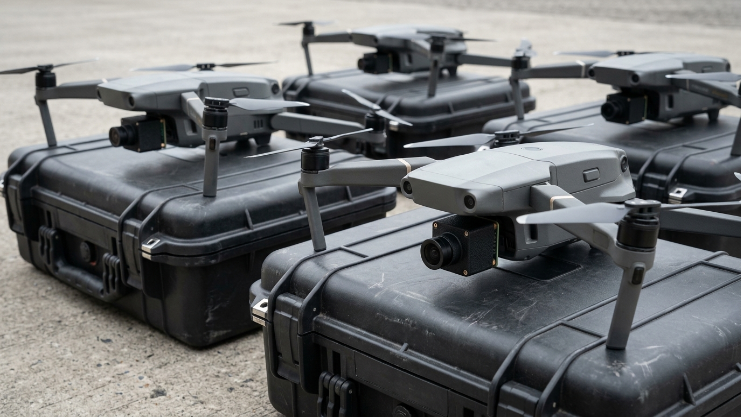
What Defines a Reliable FPV drone Vision System
A reliable FPV drone vision system is defined by:
- Low latency (real-time feedback alignment)
- Low-light interpretability (readable scenes under non-ideal conditions)
- Signal stability (consistent transmission under motion and interference)
- AI-ready input (usable data for perception models)
- Integration reliability (predictable behavior after deployment)
A vision system directly determines decision reliability by controlling the quality and timing of visual input under real operating conditions.
Most teams evaluate these factors individually.
In reality, they fail together—and so does the system.
Why Resolution Alone Leads to Wrong Decisions
Resolution improves detail but does not define system behavior.
In field conditions, motion, lighting variation, and transmission constraints dominate performance. A higher-resolution image does not prevent delayed feedback, unstable transmission, or unreadable scenes.
Resolution directly affects visual detail, but not decision reliability, because it does not control timing, stability, or interpretability.
Most systems that underperform in the field were selected based on resolution.
The issue is not image quality—it is decision quality.
How Does Latency Affect Control and Navigation?
Latency is a control variable, not a display metric.
Even small delays create a mismatch between real-world conditions and system response. The system reacts to a previous state instead of the current one.
Latency directly determines control accuracy by aligning system response with real-time environmental conditions.
If latency is not controlled, FPV drone systems accumulate correction errors during operation.
This is not a viewing issue—it is a control failure.
Why Does Low-Light Performance Determine Decision Reliability?
Real environments are not visually stable.
Inspection scenes include shadows, glare, reflective surfaces, and rapid illumination changes. In these conditions, detail is secondary to interpretability.
Low-light performance directly determines decision reliability by preserving interpretable visual input under non-ideal lighting conditions.
If visual input loses interpretability, both human judgment and AI perception degrade.
The model does not fail first—the input does.
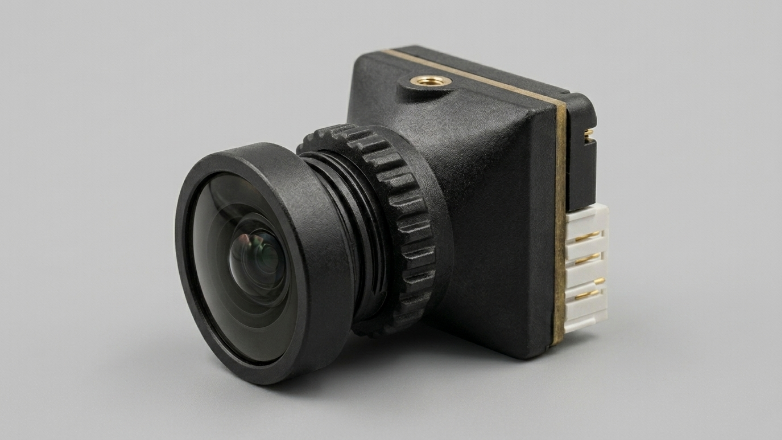
Why Does Signal Stability Define System Trust?
Bench performance does not reflect real deployment conditions.
Vibration, interference, and power variation affect transmission consistency. Even intermittent instability introduces uncertainty.
Signal stability directly determines system predictability by ensuring continuous visual feedback under real operating conditions.
If stability is not maintained, operators and AI systems compensate for the system instead of focusing on the task.
This reduces trust—and performance.
Why Does Integration Define System Risk?
A vision system is not a standalone component.
It becomes part of a constrained platform.
Mechanical fit, voltage tolerance, connectors, and thermal behavior determine whether integration is stable or problematic.
Integration reliability directly determines system risk by controlling how the vision system behaves after deployment.
Most integration issues are not visible during evaluation.
They appear after deployment—when correction is expensive.
How Does AI-Readiness Affect System Capability?
For FPV projects that include onboard AI, perception input must be evaluated alongside the pilot video path.
Detection, tracking, navigation, and scene understanding rely on consistent, timely, and interpretable input.
AI-readiness directly determines perception reliability by ensuring input data remains stable and usable for algorithms.
If input degrades, AI performance degrades—even if the model is correct.
Resolution vs Decision Reliability
| Factor | What It Directly Affects | Real Impact |
| Auflösung | Visual detail | Secondary in real-time systems |
| Latenz | Reaction timing | Determines control accuracy |
| Low-light | Scene interpretability | Determines decision reliability |
| Stabilität | Signal consistency | Determines system predictability |
| Integration | Deployment behavior | Determines system risk |
Engineering Evaluation Checklist
Before selecting a FPV drone vision system, verify:
- Can latency remain consistently low under real transmission conditions?
- Does the system maintain interpretable visual input in mixed and low-light environments?
- Is signal transmission stable under vibration and interference?
- Does the input remain reliable for AI perception tasks?
- Can the system integrate without electrical, thermal, or mechanical compromise?
Evaluation criteria directly determine deployment success by identifying risks before integration.
If any of these fail, the system risk appears after deployment—not before.
Frequently Asked Questions
What is the most important factor in a FPV drone vision system?
Decision reliability is the most important factor because it determines whether the system can respond correctly in real time.
Resolution alone does not ensure reliable operation under real-world constraints.
How does latency impact FPV drone performance?
Latency directly affects FPV drone performance by introducing delay between real-world conditions and system response.
Higher latency reduces control accuracy and increases correction error.
Why is low-light performance critical for FPV drones?
Low-light performance directly affects decision reliability by maintaining interpretable visual input in non-ideal environments.
Poor visibility reduces both human and AI confidence.
Does better image quality improve AI performance?
AI performance depends on input reliability, not visual appearance, because models require stable, timely, and interpretable data.
High-resolution but unstable input degrades results.
Why does integration matter more than expected?
Integration directly affects system reliability by determining how the vision system behaves within real hardware constraints.
Poor integration introduces hidden risks after deployment.
Conclusion
A FPV drone vision system should not be selected based on resolution alone.
It should be evaluated based on how reliably it supports real-time decisions.
Latency, low-light interpretability, signal stability, AI-readiness, and integration reliability together define whether a system performs—or fails—in the field.
CTA
Before committing to a vision system that may introduce hidden risk,
discuss your real deployment constraints with our engineering team.
Evaluate Your Vision System Setup