
Antwortzusammenfassung
FMV and EO/IR requirements are often written as procurement or payload terms, but they create engineering obligations across the full video path. For FPV drone projects, the evaluation should include the camera, encoding, transmission, receiver-side decoding, display path, ground-station workflow, power conditions, and configuration repeatability. A camera that produces a clear image is only useful if the integrated video path remains current, stable, usable, and repeatable under defined conditions.
Procurement language is changing the camera decision
FPV drone video projects used to be discussed mainly through camera specifications.
Resolution.
Sensor size.
Frame rate.
Lens field of view.
Low-light sensitivity.
Those variables still matter. But they are no longer enough.
More FPV drone requirements are now written in terms such as:
- FMV;
- EO/IR payload;
- sensor payload integration;
- video transmission;
- video return;
- ground-station workflow;
- real-time or near-real-time visual feedback.
These are not simple camera-shopping terms. They are system-integration terms.
When a buyer asks for FMV, they are not only asking whether a camera can output video. They are asking whether the operator, ground station, recorder, or downstream system can receive visual information that is current enough, stable enough, and usable enough for the intended workflow.
When a requirement mentions EO/IR, it should not be reduced to a sensor label. It usually means the video architecture must clarify how visible-light, low-light, thermal, or other payload data will be captured, transmitted, displayed, and reviewed. The exact payload boundary should be confirmed before selection.
When a specification mentions video transmission, the question is not only whether a link exists. The question is whether the full camera-to-ground-station path can preserve image usability, timing behavior, overlay readability, receiver-side stability, and repeatable configuration.
This changes how FPV drone teams should evaluate camera systems.
The better question is not:
“Which camera has the right spec?”
Die bessere Frage ist:
“Can this video path satisfy the requirement after the module is integrated into the actual platform?”
Why FMV is a video-path requirement, not a camera feature
FMV is often treated as if it means “live video.”
That is too loose for engineering review.
For FPV drone systems, FMV creates a chain-level requirement. The system needs to move visual information from the camera to the operator, ground station, recorder, or processing workflow without creating hidden delay, frame instability, or receiver-side usability problems.
A clear camera output does not guarantee FMV usability.
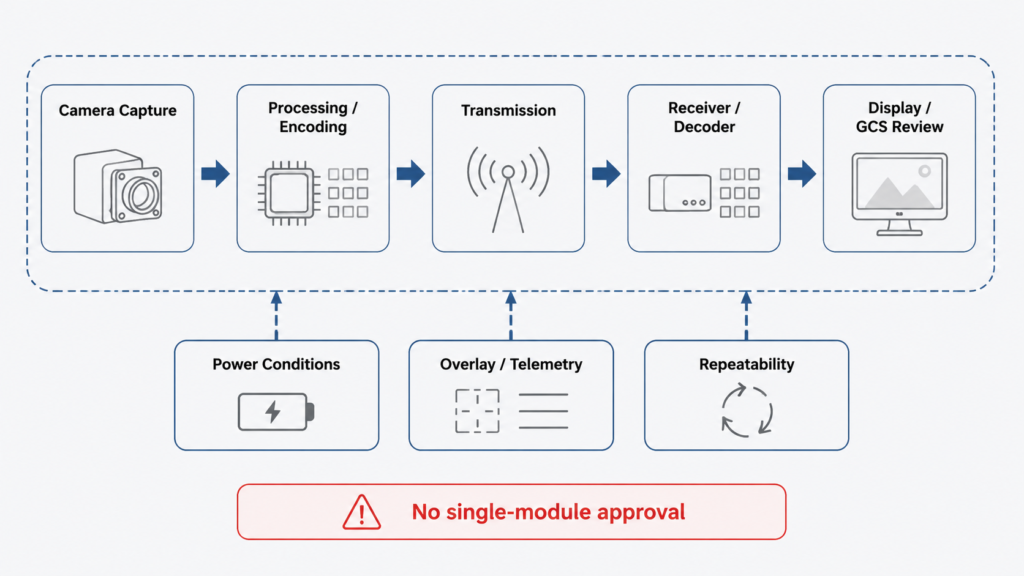
The video may still fail after integration because:
- encoding adds delay;
- overlay or telemetry data is not aligned with the final workflow;
- transmission behavior changes under the selected bandwidth and environment;
- receiver-side decoding adds buffering;
- the display or ground-station software freezes or lags;
- power variation creates packet loss or unstable output;
- the prototype configuration cannot be repeated in later builds.
FMV should therefore be reviewed as a complete video path.
The evaluation boundary should answer:
- Where is latency measured?
- Does the test include encoding and decoding?
- Does it include overlay or telemetry information?
- Does it include the selected receiver and display?
- Does it include the ground-station software?
- Does the feed remain stable during motion, low light, and longer-duration operation?
- Can the same configuration be repeated after prototype approval?
Without those answers, an FMV requirement may be satisfied on paper but fail during platform integration.
Why EO/IR language should trigger payload-boundary review
EO/IR is another term that can become misleading if it is treated only as a product category.
A FPV drone project may use visible cameras, low-light cameras, thermal sensors, or other imaging payloads. But the engineering risk is not limited to the sensor itself.
The payload boundary should be defined first.
Engineering teams should clarify:
- Which part of the payload is visible-light imaging?
- Which part is low-light or thermal imaging?
- Which sensor output needs to be transmitted?
- Will multiple video streams need to be synchronized?
- Will the operator view one feed, multiple feeds, or a fused display?
- What receiver, decoder, display, and ground-station workflow will be used?
- What lighting condition, distance, target motion, and lens requirement define image usability?
- What data needs to remain visible through overlay or telemetry information?
This is where many camera evaluations become too narrow.
A sensor can perform well in isolation, while the final payload workflow becomes difficult to use because the video output, encoding format, receiver path, display behavior, or power architecture was not reviewed early enough.
For EO/IR-related projects, the safest evaluation question is not:
“Does this supplier offer an EO/IR camera?”
Die bessere Frage ist:
“Which parts of the EO/IR video path can be verified under defined conditions, and where does the payload integration boundary end?”
This protects both the buyer and the supplier from overclaiming.
The hidden failure mechanisms behind procurement terms
Procurement terms sound simple because they are written for requirements documents.
Engineering implementation is less simple.
1. Undefined latency boundary
A low-latency number is incomplete unless the measurement boundary is defined.
Camera-side delay, encoding delay, transmission delay, receiver processing delay, display delay, and ground-station software delay are not the same measurement.
For FMV and video return workflows, the useful question is whether the final operator view remains current under the selected resolution, frame rate, protocol, receiver, display, and software setup.
2. Receiver-side instability
Many video problems are discovered late because engineering teams focus first on the camera and transmission side.
But the receiver determines how the video is decoded, displayed, recorded, monitored, or passed into the ground-station workflow.
A stream that works in one player or laptop setup may behave differently in another decoder, embedded display, mobile ground station, desktop display path, or GCS software environment.
Receiver-side behavior should therefore be included in the evaluation before the platform architecture is locked.
3. Overlay and telemetry mismatch
Overlay and telemetry information are often treated as secondary details.
In FPV drone integration, they may be part of the operator workflow.
If flight data, status information, or payload context is not readable in the final video path, the feed may be less useful even when the camera image is clear.
Overlay and telemetry requirements should be reviewed with the selected receiver, display, and ground-station workflow, not only at the camera or air-unit level.
4. Power variation and platform noise
FPV drone platforms do not provide perfect lab power.
Battery behavior, motor load, cable routing, electrical noise, and voltage variation can affect video stability.
If power conditions are not reviewed, intermittent video issues may appear as random link problems, camera problems, or receiver problems.
Power behavior should be treated as part of video-path evaluation, not only as an electrical detail.
5. Prototype success without repeatability
One successful prototype does not prove that the configuration is ready for repeatable builds.
A prototype may work because one exact combination of firmware, bitrate, receiver, display, cable layout, and software version happens to behave correctly.
For OEMs and system integrators, the more important question is whether the same video behavior can be documented, reproduced, and reviewed again in later builds.
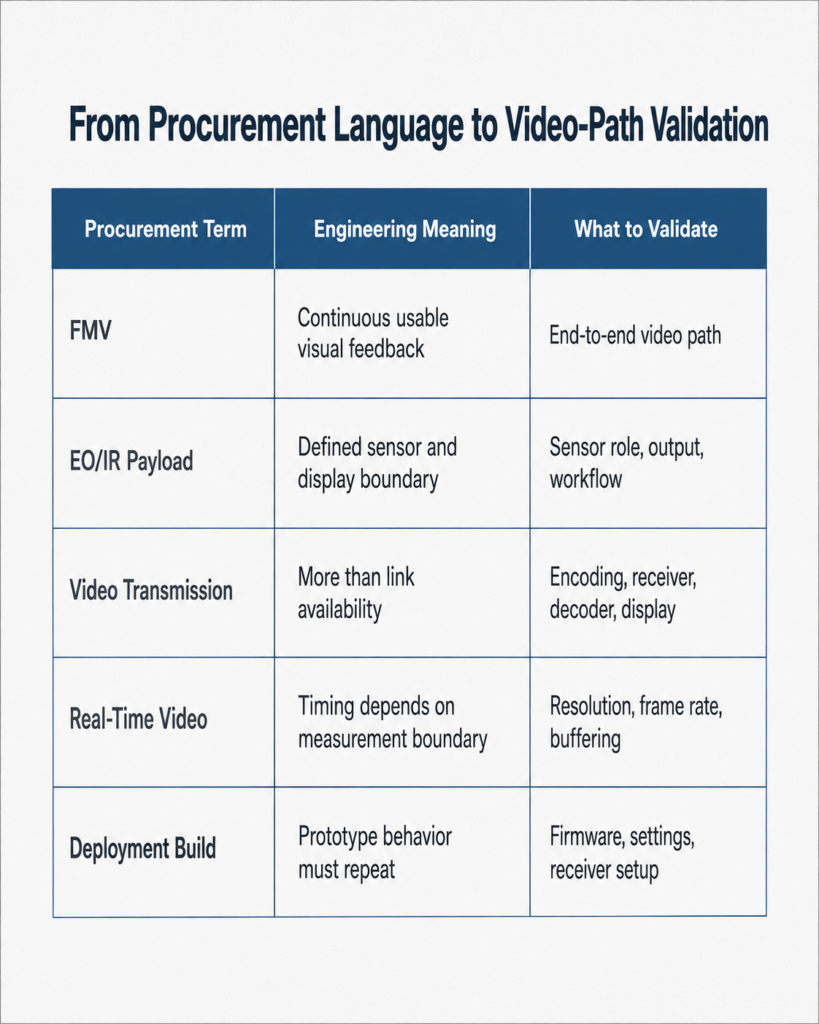
A procurement-to-engineering translation framework
Before selecting a camera module or video air unit, teams should translate procurement language into engineering validation questions.
| Procurement Language | What It Usually Means in Engineering | What to Validate |
|---|---|---|
| FMV | Continuous visual feedback that remains useful after integration | End-to-end video path, latency boundary, frame stability, receiver behavior, display workflow |
| EO/IR payload | Imaging payload with defined sensor roles and display requirements | Sensor boundary, visible / low-light / thermal role, output format, payload interface, video path |
| Video transmission | More than link availability | Encoding, bitrate, protocol, receiver, decoder, display, recovery behavior |
| Sensor payload integration | The camera is part of a larger platform architecture | Mechanical fit, power conditions, interface, overlay / telemetry, payload controller, repeatability |
| Real-time / near-real-time video | Timing must be defined by use case | Measurement boundary, resolution, frame rate, compute load, receiver and display delay |
| Deployment build | Prototype behavior must be repeatable | Configuration documentation, firmware version, settings, receiver setup, build consistency |
This framework moves the evaluation away from generic camera comparison and toward integration evidence.
That is the level of review engineering teams need before they approve a video module for an FPV drone platform.
What engineering teams should ask before module selection
A stronger first conversation should include these questions.
Video-Pfad
What is the complete path from camera to operator view?
Include camera capture, image processing, encoding, overlay or telemetry, transmission, receiver, decoder, display, and ground-station software.
Latency boundary
Where should latency be measured?
Camera output only is not enough if the project depends on final operator feedback.
Resolution and frame rate
What resolution and frame rate are required after encoding, transmission, decoding, and display?
A camera output number should not be treated as the final workflow number.
Receiver and GCS workflow
Which receiver, decoder, display, operating system, and ground-station software will be used?
The receiver side should be reviewed before the platform architecture is locked.
Overlay and telemetry
Is overlay or telemetry information required?
How will it be added, displayed, verified, and repeated in later builds?
Power conditions
What voltage behavior, battery condition, cable routing, and load variation exist on the platform?
Power behavior should be treated as part of video stability, not only as an electrical detail.
Repeatability
Will the same configuration need to be reproduced across multiple builds?
If yes, firmware, settings, receiver setup, bitrate, mounting, and cable layout should be documented early.
Where Thyraon fits
Thyraon works with camera systems and video integration modules for FPV drone projects.
In an FMV, EO/IR, or video-transmission review, the first step should not be to turn every requirement into a product claim. The first step should be to define the video-path boundary.
Before selecting or adapting a camera module, engineering teams should clarify the following review points:
- what the camera must capture, and under which lighting, motion, distance, and field-of-view conditions;
- where the video path begins and ends;
- whether encoding, transmission, receiver-side decoding, display, and ground-station software are included in the evaluation;
- whether overlay or telemetry information is required in the final operator view;
- which receiver, decoder, display, operating system, and GCS workflow will be used;
- what platform power conditions may affect video stability;
- which resolution, frame rate, bitrate, and protocol settings need to be tested together;
- whether low-light image usability must be defined by test conditions rather than by a generic sensor label;
- whether the prototype configuration needs to be repeated across later builds.
This checklist does not assume that one module fits every platform. It helps the buyer and supplier define what must be verified before a camera or video module is treated as suitable for the project.
For EO/IR-related requirements, the same boundary discipline is important. Visible-light imaging, low-light imaging, thermal payloads, output formats, display workflows, and payload-control requirements should be separated before capability claims are made.
That review process protects the project from a common integration mistake: approving a camera because it produces a clear image, then discovering later that the complete video path is not current, stable, usable, or repeatable in the actual platform workflow.
Conclusion
Procurement language is becoming more system-level.
FMV, EO/IR, sensor payload, and video transmission are not just keywords. They are signals that the buyer is evaluating whether the full video path can support the intended FPV drone workflow.
A camera can be clear and still fail the integration review.
A video link can exist and still produce delayed or unstable operator feedback.
A prototype can work once and still fail repeatable deployment.
For FPV drone OEM and integration teams, the stronger evaluation method is to translate procurement terms into testable engineering questions.
The practical goal is not to buy a camera.
The practical goal is to validate a camera-to-ground-station video path that remains current, stable, usable, and repeatable under defined integration conditions.
Send Thyraon your target video path: platform type, required resolution and frame rate, lighting conditions, overlay or telemetry needs, receiver setup, display path, ground-station workflow, and latency measurement boundary.
The goal is to clarify what must be verified before the camera or video module is selected.
FAQ
What is FMV video integration?
FMV video integration means reviewing whether the complete video path can deliver usable visual feedback from the camera to the operator, recorder, ground station, or processing workflow. It should include camera capture, image processing, encoding, transmission, receiver, decoder, display, and software workflow.
Why is EO/IR not only a camera-selection question?
EO/IR requirements often involve payload boundaries, sensor roles, output formats, display workflows, and integration conditions. Engineering teams should clarify which parts of the imaging payload need to be supplied, transmitted, displayed, synchronized, or reviewed.
Why is a clear camera image not enough?
A clear image at camera output can become delayed, compressed, unstable, unreadable, or difficult to display after encoding, transmission, receiver-side decoding, display buffering, or ground-station software handling.
What should buyers ask before selecting a FPV drone video module?
Buyers should ask for the target resolution, frame rate, encoding workflow, overlay or telemetry requirement, receiver setup, GCS software, latency boundary, power conditions, and repeatability requirements before selecting a module.
Does low latency mean the same thing for every FPV drone project?
No. Low latency depends on where it is measured and what the test includes. A meaningful latency review should define resolution, frame rate, interface, encoding, transmission, receiver, decoder, display, and ground-station conditions.
Does Thyraon provide a complete FPV drone solution?
Thyraon works with camera systems and video integration modules for FPV drone projects. Platform-level flight control, full aircraft design, and complete mission-system claims should be reviewed separately.