
Onboard AI.
Choose the configuration.
Bring the camera inputs, onboard recognition / tracking functions and result interface into one FPV integration review. Compare C1–C4 here, then define the exact unit and sample test.
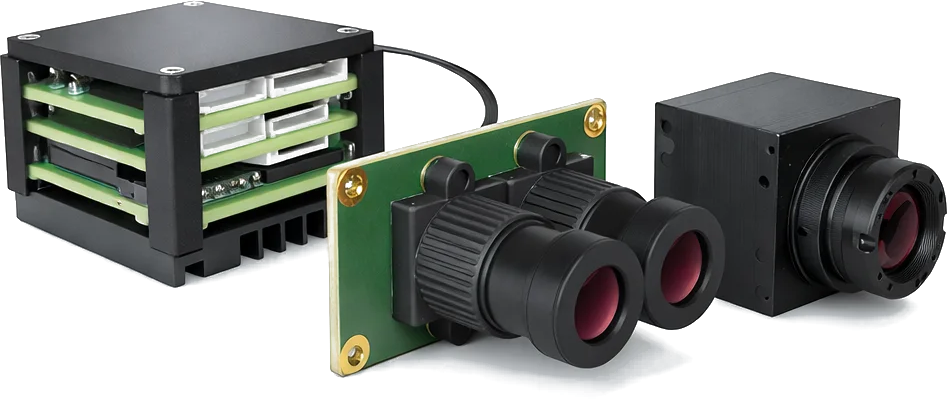
Know what runs on board.
Selected models process video for recognition and tracking. Confirm the documented functions, input configuration and output for the exact model and firmware.
- Camera inputsVisible / thermal by model
- Onboard AI moduleDocumented processing functions
- Result interfaceExact protocol and electrical path
- Customer systemFlight control and final validation
The AI module is one stage in the aircraft architecture. It does not establish a complete perception, navigation or autonomy system.
Four configurations.
Different integration questions.
The configuration names below follow the existing C1–C4 documentation. Final hardware, included cameras and firmware must be confirmed before sample selection.
THY-AI-C1 · Single visible input
A starting point for evaluating recognition and tracking with one visible camera.
Confirm the camera, lens, result interface and firmware for the selected unit.
THY-AI-C2 · Dual visible inputs
Review a two-camera visible configuration against your required framing and onboard-processing workflow.
Camera count alone does not establish stereo depth, synchronization or automatic image fusion.
THY-AI-C3 · Dual visible + thermal input
Evaluate visible and thermal inputs within the documented onboard-processing configuration.
APM / PX4 are UNDER DEVELOPMENT. Do not treat them as supported firmware.
THY-AI-C4 · Compact AI processing board
Review the board’s documented video / host interfaces and optional visible camera against the aircraft’s architecture.
Camera option, firmware, pinout and host behavior require exact-unit review. Conflicting range and speed claims are omitted.
Compare the interfaces
alongside the inputs.
On mobile, scroll the comparison horizontally to keep each model’s values together.
| Review item | THY-AI-C1 | THY-AI-C2 | THY-AI-C3 | THY-AI-C4 |
|---|---|---|---|---|
| Input configuration | Single visible camera | Dual visible cameras | Dual visible + thermal camera | Optional visible-light camera |
| Source-listed AI compute | 1 TOPS | 6 TOPS | 6 TOPS | 6 TOPS |
| Documented result / host path | CRSF | CRSF | CRSF | UART / Ethernet interface review |
| Firmware review | Betaflight; exact version / board review | Betaflight; exact version / board review | Confirm selected firmware. APM / PX4: UNDER DEVELOPMENT | Exact firmware and host review required |
| Source-listed supply | 9–16 V | 9–16 V | 9–16 V | 9–16 V |
| Selection status | CUSTOMER VERIFICATION REQUIRED | CUSTOMER VERIFICATION REQUIRED | CUSTOMER VERIFICATION REQUIRED | UNCONFIRMED — exact-unit review |
C1–C3: AI Cobra specification, model comparison and development-kit documentation. C4: model-specific manual and communication documentation. Computing power does not establish recognition accuracy or aircraft performance. Distance, speed and latency values are not generalized across models.
Define the hand-off
to your aircraft.
Bring the actual receiving device and firmware into the review. Verify the electrical path before attempting the connection.
- Camera and scene
- Confirm each input, camera option, lens, field of view, illumination or thermal contrast, movement and installation.
- Result interface
- Confirm the output format, connector, pinout, signal direction, voltage levels and protocol for the exact unit.
- Firmware and platform
- Record both sides’ firmware versions and configuration. A documented protocol or firmware name does not establish full compatibility with every board.
- Power and fit
- Review supply, cable route, mounting points, lens clearance and heat dissipation against the selected assembly.
- Customer responsibility
- The customer retains the aircraft control system, pilot workflow, autonomy architecture and final platform validation.
Give the sample
a specific job.
Agree the scene, configuration and observable result before evaluation. Keep recorded footage and interface results with the test setup.
Select the exact setup
Record the AI model, hardware revision, cameras, lenses, firmware and receiving interface.
Exercise the workflow
Test the required recognition / tracking behavior and result output under agreed lighting, motion, contrast and installation conditions.
Review acceptance
Record results, limits and remaining issues. Include target loss / reacquisition and startup or reconnection behavior where relevant to the documented workflow.
Bring the documents
into the review.
Request documentation for the exact model and revision. Availability and release status are confirmed during the review; supplier source files are not published here.
Configuration & installation
Ask for the approved specification, assembly contents, dimensions, mounting drawing and power / connector information.
Interface & evaluation
Ask for the applicable communication protocol, firmware status, input / output details and sample-evaluation requirements.
Questions before selection.
Keep capability, compatibility and evaluation evidence attached to the exact model.
Does every AI model accept thermal input?
No. The documented C3 configuration includes thermal input. Do not apply that configuration to C1, C2 or C4 without an exact-model source.
Does dual visible input mean stereo vision?
No. Two camera inputs alone do not establish calibrated geometry, synchronization or depth output. Confirm the functions documented for the selected configuration.
Are APM and PX4 supported on C3?
They remain UNDER DEVELOPMENT in the retained documentation. Confirm current release status before choosing an evaluation configuration.
What should we put in the Support message?
Include the preferred model, camera inputs, required result, receiving device, firmware versions, supply and mounting constraints, and the scene / acceptance criteria for the sample.
Your cameras.
Your evaluation.
Use the Support form to share your equipment, required video input and integration questions. Include the product or application you are evaluating.